Restaurant Website Trends 2026: How AI Is Transforming the Digital Dining Experience
Restaurant Website Trends 2026: How AI Is Transforming the Digital Dining Experience
The restaurant website used to have one job: tell people where to eat and what's on the menu. In 2026, that job description has expanded dramatically. Diners now expect a site to recommend a dish, remember their last order, answer a question in real time, and show up correctly whether they're searching on Google or asking ChatGPT where to eat nearby.
That shift is being driven almost entirely by artificial intelligence in restaurants, and it's happening fast enough that restaurants sitting on a five-year-old website are starting to notice the gap. Here's what's actually changing, why it's happening now, and what it means for the industry.
Why This Is Happening Now
Restaurant technology has been inching toward automation for years online ordering, QR code menus, loyalty apps. What's different in 2026 is the scale and speed of AI adoption across nearly every part of the guest journey, not just the back office.
Industry researchers tracking the sector describe 2026 as a year of fundamental change, driven by shifting consumer behavior, ongoing economic pressure on operators, and fast-moving advances in AI technology, with global foodservice sales expected to surpass $4 trillion as digital dinner experience innovation and demand for convenience and personalization accelerate. In short, the money is moving toward restaurants that can deliver a faster, more tailored experience.
Key Ways AI Is Transforming Restaurant Websites
1. Personalization Is No Longer a Bonus Feature
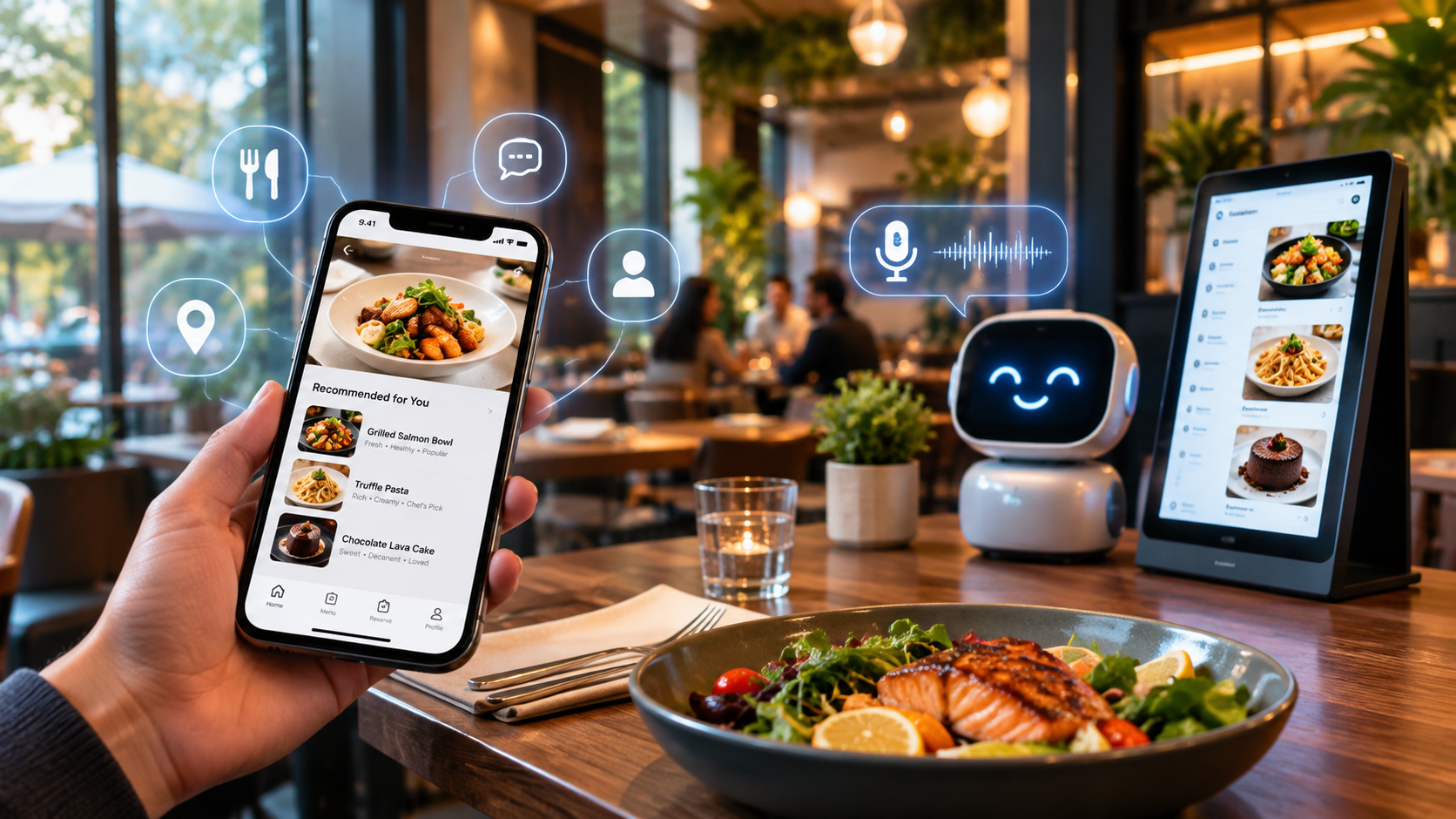
One of the clearest shifts this year is how much restaurant websites now adapt to the individual visitor rather than showing every guest the same static page.
Analysts following the space expect AI in 2026 to shape customized menu suggestions, tailored promotions, and dynamic content based on how a user behaves on the site. That tracks with broader consumer expectations: a widely cited Oracle Food and Beverage study found the large majority of consumers now expect brands to deliver personalized experiences online
On the operations side, this same logic is showing up in loyalty and marketing tools. AI Restaurant technology platforms are increasingly using behavior-based segmentation to separate lapsed guests from regulars and high-value occasion diners, then serving different offers to each group rather than blasting the same discount to everyone.
What this looks like in practice:
1. A returning visitor sees their previously ordered dish surfaced first
2. First-time visitors get broader "popular dishes" recommendations
3. Promotions shift based on time of day, weather, or past order history
4. Loyalty dashboards flag which offers actually drive repeat visits versus which ones just train guests to wait for a discount
2. Mobile-First Design Has Become Non-Negotiable
Restaurant website traffic has tipped decisively toward phones. Current estimates put mobile traffic at over 60% of all restaurant website visits, which is pushing operators to prioritize speed and responsiveness over desktop-first layouts that once dominated the space.
That matters because a slow-loading menu or a reservation form that breaks on a small screen doesn't just annoy a visitor, it sends them straight to a competitor's site or, increasingly, straight to a delivery app instead.
3. Diners Are Searching for Restaurants Through AI, Not Just Google
Perhaps the biggest structural shift is where diners are actually looking for restaurants in the first place. Search behavior is fragmenting beyond traditional search engines.
Recent research on this shift found that while most hungry consumers still look for new places to eat on Google and similar search engines, roughly one in five now use AI tools like ChatGPT to find somewhere to eat. In response, restaurant operators say they intend to keep optimized for digital presence and visibility everywhere people search, not just on Google, which includes moving away from static PDF menus toward interactive, page-by-page menu structures that AI systems and search engines can actually read and index.
This has given rise to a new category of optimization work sometimes called "generative engine optimization," or GEO essentially SEO's cousin, but built for the era when an AI chatbot, not a search results page, is answering "where should I eat tonight?"
4. Voice and Conversational Interfaces Are Moving Into the Front of House
Voice ordering AI has quietly become one of the most consequential restaurant technologies of 2026, and it's increasingly tied directly into the website and ordering experience rather than sitting off to the side as a novelty.
Phone orders still make up a meaningful share of business for many restaurants, an estimated 15 to 25 percent of off-premise orders, especially among older customers and in markets where app adoption lags. Handling those calls manually is expensive: a staff member typically needs three to five minutes per phone order. Voice AI systems are now stepping in to answer routine calls automatically with accuracy rates above 90 percent, freeing staff during peak hours and ensuring calls aren't missed altogether.
Major chains are leaning into this publicly. Industry coverage notes that Wendy's has been expanding voice AI in its drive-thru lanes as part of a broader push to automate front-of-house operations at scale.
Some of this voice and chatbot functionality is also making its way onto restaurant websites directly, giving visitors a conversational way to ask about allergens, hours, or availability instead of hunting through a static.
5. AI Is Reaching Into the Menu Itself
The influence of AI isn't limited to how a website looks or ranks, it's increasingly shaping what actually ends up on the menu that gets published there.
Generative AI tools are now being used by kitchens to help develop new dishes, test flavor combinations, and build out full menus more quickly, with AI models trained on global cuisine data used to predict which flavor pairings will land and to generate allergen-friendly or diet-specific versions of existing dishes. When an AI restaurant's website menu updates, in other words, AI may have had a hand in it well before the page was ever built.
6. Immersive and Visual Storytelling Is Growing
Static photo galleries are giving way to richer visual formats. Industry trend-watchers point to high-quality video content and early use of AR and VR features as tools restaurants are adopting to boost engagement and keep visitors on the page longer, treating the website less like a brochure and more like a preview of the actual dining experience.
7. Sustainability Data Is Becoming Part of the Digital Story
Diners increasingly want transparency about where their food comes from, and AI-driven tools are helping restaurants supply it. Some operators are now using AI-powered demand forecasting to cut food waste substantially, with one fast-casual example reportedly reducing weekly food waste by around 30 percent through better prediction of ingredient needs. Others are experimenting with blockchain-based supplier verification, letting a diner scan a QR code to see exactly where a piece of fish was caught.
As these practices spread, expect more restaurant websites to surface this information directly on a sustainability page, a supply-chain callout, or a waste-reduction stat rather than keeping it purely as a back-of-house initiative.
Quick Comparison: Restaurant Websites, Then vs. Now
| Element | Pre-AI Restaurant Website | 2026 AI-Enhanced Restaurant Website |
|
Menu |
Static PDF or image |
Interactive, indexable, dish-by-dish pages |
|
Search visibility |
Google-only SEO |
SEO plus AI answer-engine optimization (GEO) |
|
Content shown |
Same for every visitor |
Personalized based on behavior and history |
|
Ordering |
Manual phone calls, basic online form |
AI voice ordering, chat-based assistance |
|
Promotions |
Blanket discounts |
Segmented offers by guest behavior |
|
Visuals |
Static photo gallery |
Video, immersive storytelling, early AR/VR |
Why This Matters
For diners, this shift generally translates into a faster, more relevant, less frustrating path from "hungry" to "seated" or "ordered." For restaurant operators, the stakes are more competitive than cosmetic. As guest-experience pressure builds across the industry, operators are reporting sharper focus on every step of that journey, from how a restaurant is discovered online to how easily someone can place an order and whether they come back. A restaurant that hasn't adapted its website to how people now search and order risks becoming invisible in exactly the channels where diners are looking.
It also raises the bar for what "having a website" means. A page that simply lists an address and a phone number is increasingly competing against sites that can answer questions, recommend dishes, and get indexed by AI search tools, an uneven fight that's only expected to widen over the next few years.
What to Watch Going Forward
1. Whether AI-driven answer engines like ChatGPT, Gemini, and Perplexity become a mainstream discovery channel for dining, not just a niche one
2. How quickly mid-size and independent restaurants adopt voice AI ordering compared to national chains
3. Whether generative-AI menu development becomes standard practice or stays limited to larger restaurant groups
4. How regulators and consumers respond to AI-personalized pricing and promotions as the practice becomes more common
Conclusion
Restaurant websites are no longer just digital menus with a map pin; they're becoming active, adaptive tools shaped heavily by artificial intelligence, from how a dish is created to how a diner discovers it in the first place. The trends taking hold in 2026, personalization, AI-assisted search visibility, voice ordering, and richer visual storytelling, all point in the same direction: restaurants that treat their website as a living, AI-aware part of the business are positioned to capture more of the guest journey than those that treat it as a one-time build.
Frequently Asked Questions
1. Why are restaurant websites changing so much in 2026?
Rapid advances in AI, combined with shifting consumer expectations around personalization and convenience, are pushing restaurants to make their websites more adaptive and interactive rather than static.
2. Do diners actually use AI tools to find restaurants?
Yes, a growing share does. Recent industry research found roughly one in five consumers now use AI tools such as ChatGPT to search for places to eat, alongside traditional search engines.
3. What is generative engine optimization (GEO)?
GEO refers to optimizing a website's content so it can be understood and surfaced by AI-driven answer engines and chatbots, in addition to traditional search engine optimization for platforms like Google.
4. Is voice AI replacing restaurant staff?
Not entirely. Voice AI is mainly being used to handle routine phone orders and calls during peak hours, reducing missed calls and freeing staff for other tasks rather than eliminating front-of-house roles outright.
5. Will smaller, independent restaurants be able to keep up with these AI trends?
Adoption is expected to vary. Larger chains are moving quickly on voice AI and personalization, but many of these tools are increasingly built into affordable restaurant technology platforms, making them more accessible to independent operators than in past years.
For more breaking stories, trending updates, and in-depth coverage on how technology is reshaping everyday industries, keep following Trendzyvibe your source for what's happening next.
Leave a Reply
Your email address will not be published. Required fields are marked *